E-commerce Trends 2026: interactivity, virtual assistants, personalisation and branding platforms
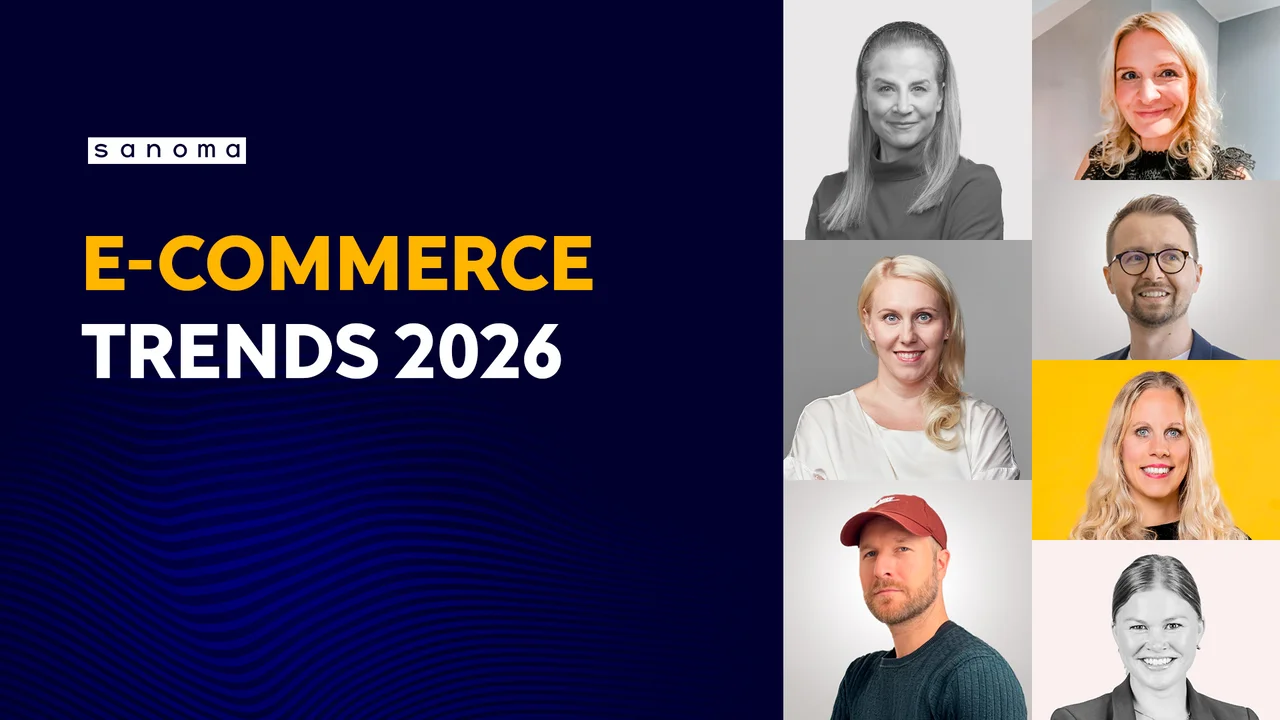

Aapeli Helkkula,
Marketing Lead
Zalando
Customers are engaged through interactivity and community
It is clear that generative AI will revolutionise e-commerce. Product search becomes conversational, visual search and virtual assistants simplify navigation, trend detection speeds up, and AI-enhanced content production enables a quick response to microtrends. Online stores that are the fastest at harnessing generative AI to improve customer experience will gain a significant competitive advantage. In the long run, however, I believe that the winners will be those who are able to build a truly interactive and collaborative customer experience.
In addition to AI, leading online stores will invest more in customer engagement through interactivity, community and loyalty programmes. Alongside brand content, user-generated content rises, and loyalty programmes reward customers not only for purchases, but also for other interactions that produce data and content. Active utilisation of customers in the development of e-commerce not only improves the customer experience, but it also promotes engagement and increases the customer's life-cycle value.
The online stores of the future will be more than just sales channels. They will be brand platforms and communities where users are inspired and create content and that they want to return to.

Juha Suomela,
Client Director
Tulos
Buying changes permanently
We are facing the biggest change in e-commerce since the spread of smartphones. AI-assisted search becomes a new starting and ending point for the purchase process.
In the past, consumers searched for information and compared products themselves. In the future, artificial intelligence will perform information retrieval and comparison based on the need or situation given to it by the user. The logic is the same as we are used to in brick-and-mortar when we talk to a knowledgeable salesperson.
For the online retailer, this means that the role of the website will change. The website becomes more of a product catalogue and data bank as the actual purchasing takes place outside the website. This is not entirely new, as social media platforms are already directing users to make purchases within the channel.
It is all about ease, speed and structured data. Uniform product information is a prerequisite for participating in the competition. Successful online stores are those that build authority, trust and social acceptance, and whose websites are technically capable of this change.

Mirva Sandström,
Director,
Digital Commerce Finland
Algorithms find customers
The old online store is where customers search for products. The new online store is where products find customers with the help of algorithms.
The three growing C's continue to be strong e-commerce trends: cosmetics, circular economy and China. Cheap Chinese online marketplaces continue to grow in Europe, and Finnish online retailers are rightly worried that low-value imports will make consumers' perceptions of prices unrealistic. China is not only the world's largest e-commerce market, but also an ecosystem living in real time.
If you take a closer look at China's growing online market, you will notice that the contrast with Europe is huge. Payment, content, logistics and communication take place within the same ecosystem. TikTok and RED are communities where inspiration and the actual purchase merge – live broadcasts and short videos create the vast majority of commerce. Artificial intelligence guides everything from logistics to personalisation, and deliveries are guaranteed in less than half an hour.
Finland is left with two questions: what can we learn from China – and do we dare to think of e-commerce as an ecosystem, not just a channel?

Veera Korvenkari,
Digital Strategist and Marketing Lead Prisma.fi,
SOK Markkinointi
The Zero-click effect shifts purchase decisions outside of online stores
The purchase path will change and become shorter as the zero-click phenomenon increasingly shifts decisions and purchases outside of online stores. Instead of targeting site traffic, visibility of the brand in places where customers make choices and purchases is critical. Social and live commerce are strengthening their position, and at the heart of everything is the value of the brand – a well-known and reliable brand lowers the purchase threshold and guides consumers' choices in a new operating environment.
The hyper-personalisation enabled by AI, which is based on customer understanding, context and behaviour data, raises the experience and requirements in online shopping to a new level – individuality becomes a real competitive advantage. Furthermore, a truly omnichannel experience will continue to drive growth in e-commerce. When mobile, brick-and-mortar and online retail merge into a seamless entity, the customer receives the best service at every meeting point.

Mirkka Mussalo,
Head of Customers,
Oikio
A successful online store will convince both people and machines
The online stores of the future will appeal to two customers: the individual and their AI assistant. You can appeal to the first with emotion, to the latter with data.
Personally, I do not believe that independent AI assistants will be mainstream in Finland in 2026, but the change has begun. The traditional purchase path will not be what it used to be.
In the AI age, e-commerce data is everything. AI agents decide their recommendations based on the data they are able to read, interpret and compare. If the information in the online store is incomplete, incorrectly formatted or unclear, the product range does not exist in the eyes of the agents.
A new concept is emerging alongside the traditional SEO: Generative Engine Optimization. The new answer engines will become the front page of the retail trade, and the product content will directly influence the AI recommendations.
Can branding be forgotten if purchasing decisions in the future are made using “common sense” and based on facts? Quite the opposite. The importance of branding is growing in the AI era. AI can analyse prices, reviews and availability in seconds, but it does not wake up wanting new running shoes or has any feelings about the brand story that resonates the most. The input information given to AI always comes from a person: from perceptions, experiences and trust. Today's customer experience is tomorrow's agent training data. If a person prefers your brand now, their AI assistant will learn to prefer it in the future as well.

Suvituuli Tuukkanen,
Chief Marketing, Communications and Sustainability Officer, Verkkokauppa.com
Artificial intelligence and speed are shaping e-commerce
Artificial intelligence will become the basic retail infrastructure, guiding product search, personalisation and customer service, and its role will also expand to purchasing. AI agents searching for, comparing, and even buying products on behalf of the customer are becoming more common, and GEO is emerging alongside SEO. Similarly to recent years, the seamlessness and effortlessness of buying will continue as trends.
Fast delivery is a key competitive advantage. A 15-minute ‘click & collect ', hourly or same-day deliveries and precise delivery promises are becoming the expected thing and they directly affect customer satisfaction and conversion.
E-commerce marketing continues to become more personalised and more data-driven. AI enables scalable targeted advertising, generative content production and dynamic campaigns. Social channels will have a bigger role than before, not only at the beginning of the purchase pipeline, but also gradually in the purchase process itself.
Alongside a strong brand, the importance of transparent product reviews, authentic and high-quality content, structured data and machine-readable product information will be emphasised in the requirements for success in 2026.

Mia Lähdesalmi,
Marketing Strategist,
Sanoma Media Finland
Omnichannel and AI-assisted purchasing are shaping commerce
The e-commerce purchase path is dispersed for good. Buying is increasingly taking place where people spend their time: in social media, media content, chats, voice services and live broadcasts. The customer moves naturally between different platforms and devices, without feeling that they are moving from one channel to another. Omnichannel means that all channels work for the customer as one entity: the purchase path can start anywhere and continue seamlessly forward without interruptions. Omnichannel is no longer a choice, but a starting point: successful online stores are genuinely present at multiple touchpoints and provide a cohesive experience throughout the shopping flow.
AI-assisted purchasing brings with chat-based product search, personalised referrals and dynamic pricing that adapts in real time to the situation and customer. Shoppable ads, live shopping and retail media combine marketing and sales in a way that reduces friction and improves performance. Especially for Gen Z, buying is discovery shopping: content-driven, fast, and often impulsive. For them, inspiration and purchase can happen in the same moment.
The online store of the future will not be a single place, but part of a larger entity where media, trade and content merge. The roles are blurred: the customer is also a content creator, a media sales channel and an e-commerce brand platform. The winners are those operators who have their own voice, credible presence and the ability to be visible and relevant, regardless of where and how the purchase decision ultimately arises.